
GREAT DECISIONS
Great Decisions: Join the Conversation!
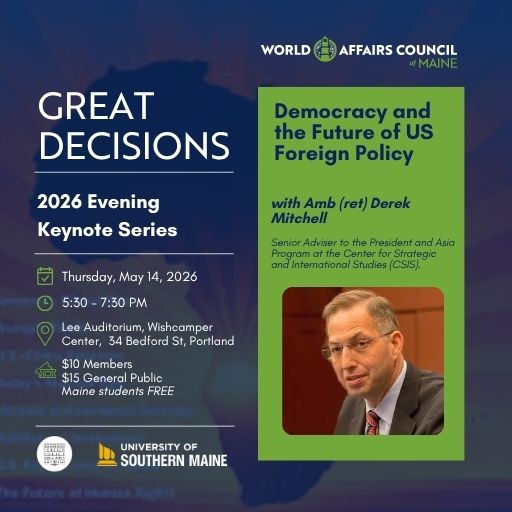
Great Decisions is the largest and longest-running conversation on foreign policy in the United States. The World Affairs Council of Maine brings this program to Mainers in two complementary ways: facilitated discussion groups at public libraries across the state, and a new evening keynote series featuring leading foreign policy experts.
Our library discussion groups—running since 1981—are free, member-led conversations where participants explore the eight global challenges selected annually by the Foreign Policy Association using their comprehensive briefing books. The evening keynote lectures deliver expert analysis on these same topics from scholars, diplomats, and policymakers. These talks are recorded to enrich discussion groups statewide, whether organized by the Council or by communities we support throughout Maine.
Together, these programs foster informed public discourse on the world issues that shape U.S. foreign policy and Maine’s place in the world.
2026 Evening Keynote Series
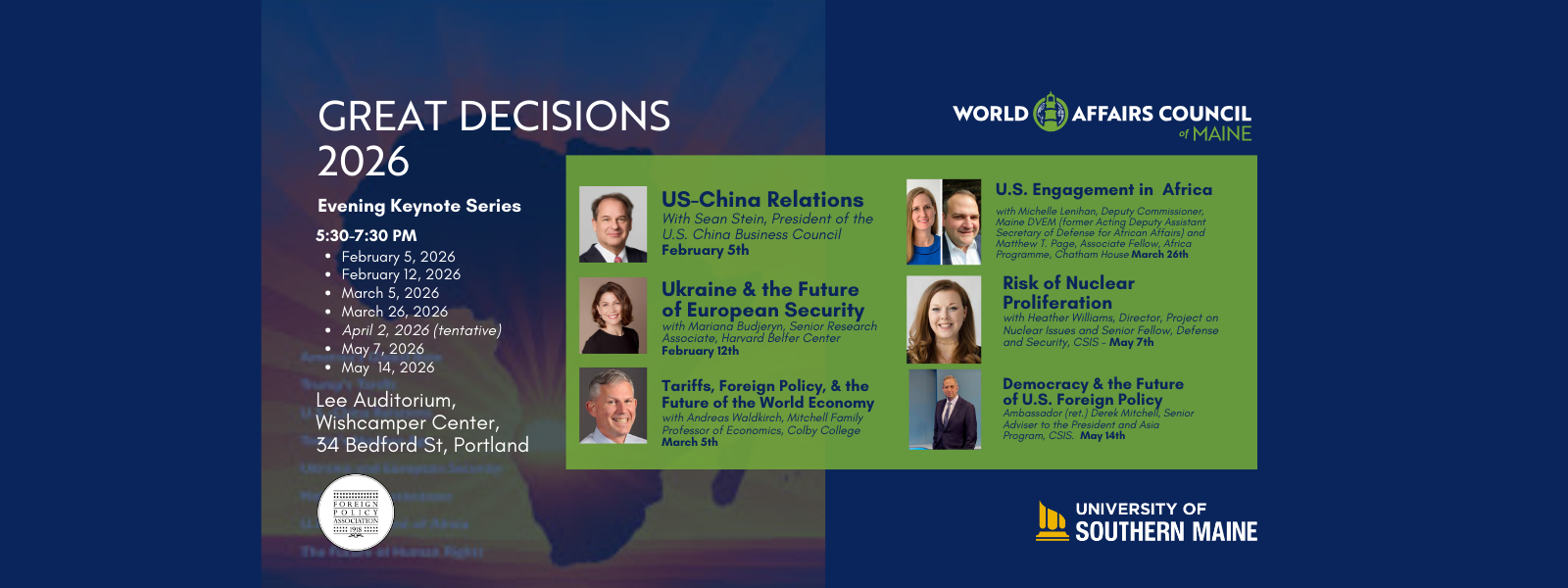
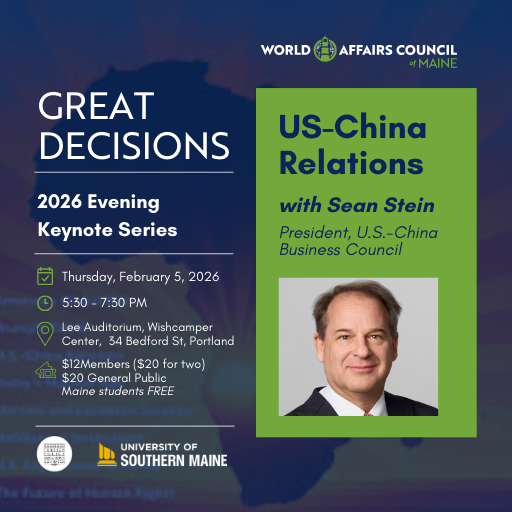
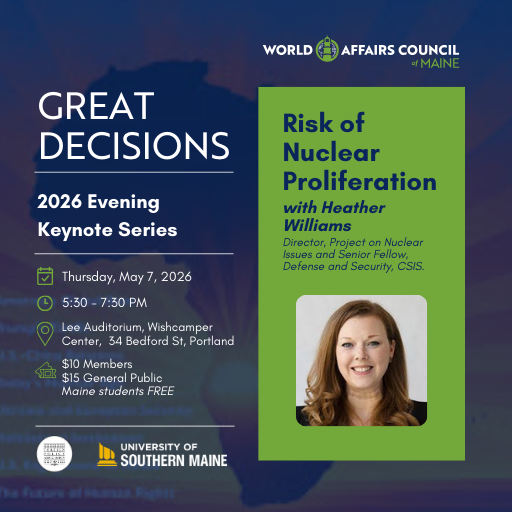
Series pass: $60 for members, $75 General Public. Individual talks: $12 for members, $20 General Public. All sessions are FREE for Maine Students!
2026 Keynotes


2026 Library Discussion Series
Registration is full. Please email Elisabeth@wacmaine.org to join the wait list.
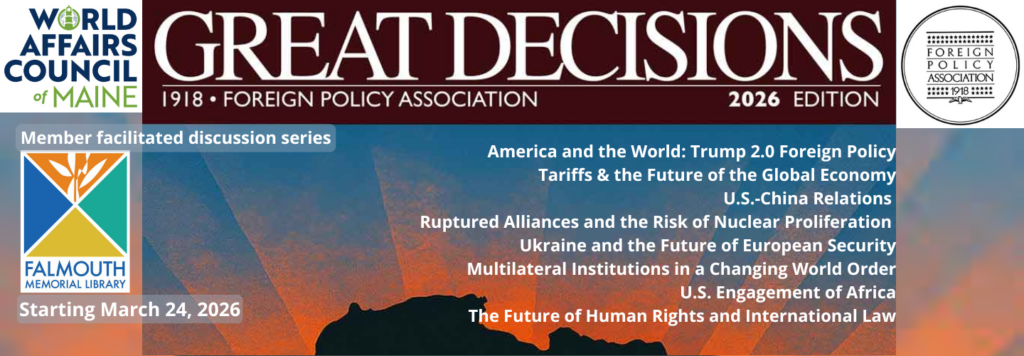
This year, the Foreign Policy Association has selected the following topics. The order of topics and session facilitators will be announced in March. Registration is for the series, including all eight topics and the final wrap up session.
- America and the World: Trump 2.0 Foreign Policy
Trump’s return has marked a break from 80 years of U.S. foreign policy leadership, embracing an “America First” approach. This chapter explores the risks of isolation and diminished influence in relation to Trump 2.0 foreign policy. - Trump Tariffs and the Future of the World Economy
Trump’s aggressive trade and tariff policies have shaken global economic norms. What’s the rationale behind this radical shift in economic policy, and what are the implications for multilateral trade and geopolitics? - U.S.-China Relations
Relations with China remain tense, with tariffs, military modernization, and pressure on Taiwan. Does Trump have a coherent China policy, and will his tariffs on Rare Earth minerals be effective? What are America’s strategic options? - Ruptured Alliances and the Risk of Nuclear Proliferation
U.S. alliance skepticism may drive countries like Japan and South Korea to reconsider nuclear options. What are the implications of the Trump administration’s rethinking of the U.S. alliance system for regional and global security? Will this new uncertainty alter the way allies and rivals in various regions make decisions about security and nuclear weapons? - Ukraine and the Future of European Security
With reduced U.S. support for NATO and Ukraine, Europe faces strategic uncertainty. The Trump administration has signaled an intention to reduce its security role in Europe. What are America’s stakes in NATO and Europe’s strategic dilemmas, and how might Europe respond? - Multilateral Institutions in a Changing World Order
Can multilateralism survive amid shifting global power and rising nationalism? This chapter examines the future of global cooperation across trade, health, and finance. - U.S. Engagement of Africa
Africa’s geopolitical role is growing. What lessons can the U.S. learn from China’s presence there, and how might it strengthen ties, especially with leading nations like Nigeria? What tools of statecraft might the U.S. bring to its engagement with Africa? - The Future of Human Rights and International Law
As democracy and human rights retreat globally—and the U.S. pulls back—how can civil society and legal norms remain effective in a divided world? What is the role and force of international law in this era of impunity? -
How do I participate?
There is no cost to participate in the series, although registration is limited to facilitate discussion. Please sign up as soon as possible, but no later than March 17th. Participants should obtain a copy of the 2026 Briefing Book* from the Foreign Policy Association HERE (eBook versions HERE). Review each chapter in advance of the session, as well as the session glossaries. There will be three copies available for in-library use at the Falmouth Memorial Library courtesy of the World Affairs Council of Maine.
The objective of the series is to foster informed dialouge on U.S. Foreign Policy and world issues. To get the most out of the program, participants should plan to attend every session.
Note: the Foreign Policy Association no longer produces documentary-style videos to accompany the briefing book. They do offer a pre-recorded “Master Class” lecture by Professor Jeffrey S. Morton, Florida Atlantic University for each topic that can be purchased through VIMEO. Recordings of the World Affairs Council of Maine’s public lecture series will also be available at wacmaine.org and on Channel 5.
Previous Great Decision Topics
2025 Great Decisions Topics
American Foreign Policy at a Crossroads
This chapter will explore the contours of the U.S. foreign policy debate as it plays out in a world of multiple and escalating crises and domestic polarization.
U.S. Changing Leadership of the World Economy
Under President Biden, the U.S. has advanced new ideas about trade, technology, industrial policy, competition with China, and the organization of the world economy. For most of the postwar era, the U.S. has tied its global leadership to cooperative agendas aimed at creating a more open world trading system, but that has apparently come to an end. What are America’s options and opportunities as a leader of the world economy? How will America’s “foreign policy for the middle class” and strategic competition with China impact its leadership role? How can the postwar rules and institutions of the world economy be made safe for economic nationalism and great power competition?
U.S.-China Relations
 Washington’s relations with Beijing have reached an ominous low ebb. Both American political parties have identified China as the country’s preeminent geopolitical challenger and, in the eyes of many, a systemic threat. What is driving this deterioration of Sino-American relations, and what are America’s strategic options in the face of Chinese power and ambition?
International Cooperation on Climate Change
The 2015 Paris Agreement established a UN-sponsored framework for negotiations on climate change and global warming. In subsequent COP meetings, experts and political leaders have come together seeking common cause for this growing global crisis. What is the future of these efforts, and what have they yielded? What is the U.S. role in fostering cooperation on climate change? In a divided country, what are the possible futures for American policy leadership?
The Future of NATO and European Security
 European security is more uncertain than it has been for decades. Putin’s Russia has launched a war with Ukraine on its doorstep, and America’s uncertain role as leader of NATO and security provider has been called into question with the failure of Congress to pass supplemental military support for Ukraine. What are Europe’s options, and how might developments on both sides of Western Europe – in Ukraine and across the Atlantic – impact its choices? What are America’s stakes in NATO and Europe’s strategic dilemmas?
AI and American National Security
The AI revolution is the leading edge of a larger high-tech revolution which promises to transform the world. Experts argue that international cooperation is needed to expand the opportunities these new technologies hold while protecting societies from their dangers. What are the key policy debates in this area, and what are the opportunities and limits on global AI rules of the road? How will the AI revolution impact American national security? What are its policy options to secure the benefits of AI and guard against its dangers?
India: Between China, the West, and the Global South
India is an emerging major power in world affairs, occupying a pivotal position between China, the United States, and the Global South. Its population size, economy, and geopolitical location ensure that it will be an influential voice in debates and political struggles over global order. What are India’s choices and opportunities for regional and global leadership? How will it maneuver between China and the United States, and what is its role as a voice of the Global South? What opportunities exist for Washington to work with India?
After Gaza: American Policy in the Middle East
The war in Gaza has brought the region to a crossroads. What are the possible outcomes of the war, and how might the United States use its influence to shape a long-term settlement that leaves both Israel and the Palestinians in a better position? How might Arab states in the wider region be brought into a settlement? What are America’s interests in the Middle East and how can it advance them
2024 Great Decisions Topics
U.S.-China Trade Rivalry
 China’s economic rise and its current policies of increasing the role of the state in the economy have led some U.S. policymakers to seek to deny China access to U.S. technology and investment. This is seen as a necessary corrective to decades of predatory Chinese economic policies. Is this a wise strategy, and how effective can it be?
Climate Technology & Competition
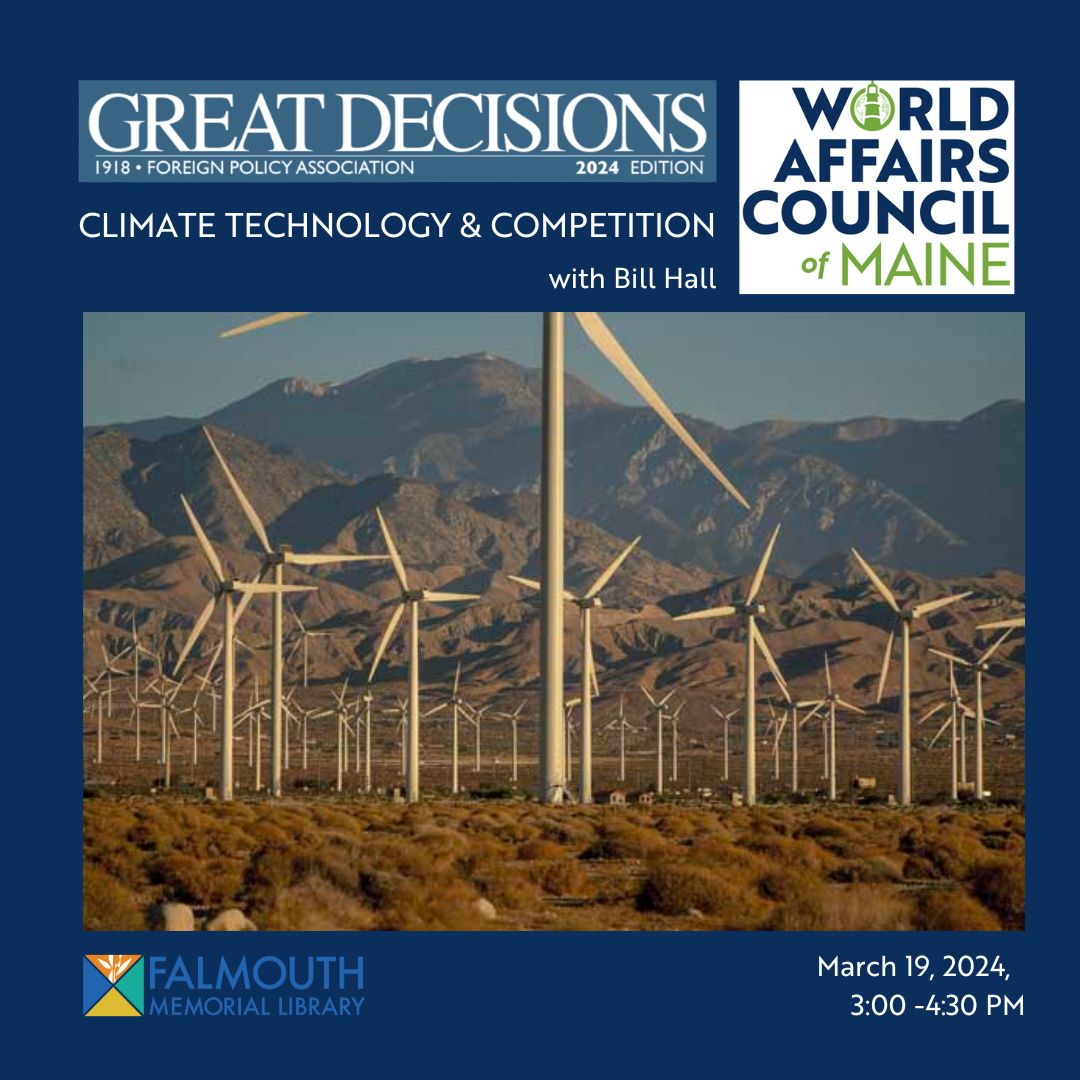 Will the United States and China, with other powerful countries following suit, approach current and future climate initiatives with an increased commitment to trade protectionism and nationalism, by various measures including trade restrictions? Or could a growing spirit of international accord develop to confront the “common enemy” of climate change?
Understanding Indonesia
Despite its large size, Indonesia remains virtually invisible to most Americans. But as one of the world’s largest democracies, the world’s largest Muslim-majority nation, and as an economic driver of ASEAN, why does it fly below the radar? What are current issues in U.S.-Indonesian relations, and what role can the country play in Asia?
NATO’s Future
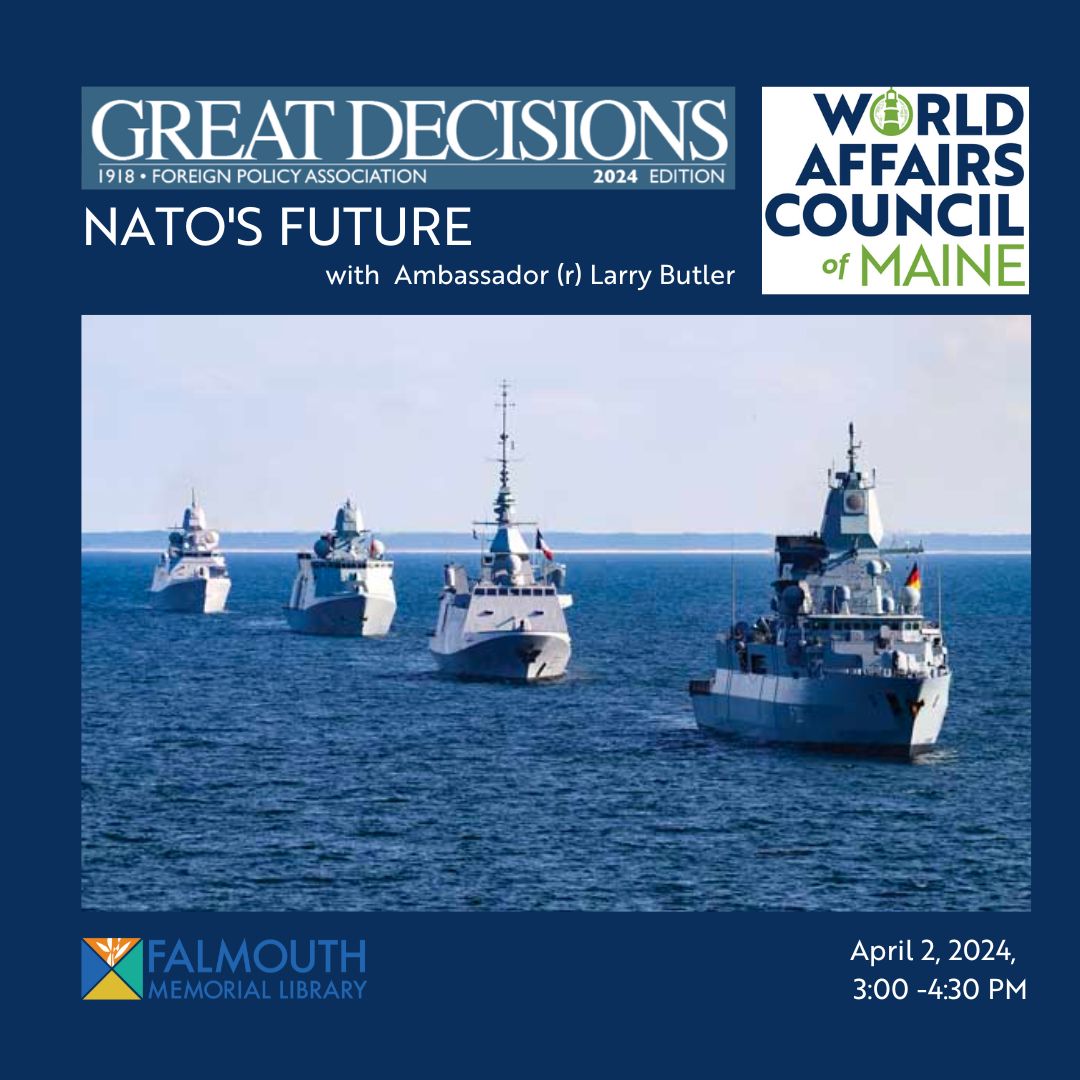 Since the Russian invasion of Ukraine in February 2022, the North Atlantic Treaty Organization (NATO) has come under increased scrutiny, not because NATO troops are involved in the conflict, but because of its role in relations between Russia and its neighbors. Will expanding membership in NATO protect countries, or will it further provoke Russia?
Mideast Realignment
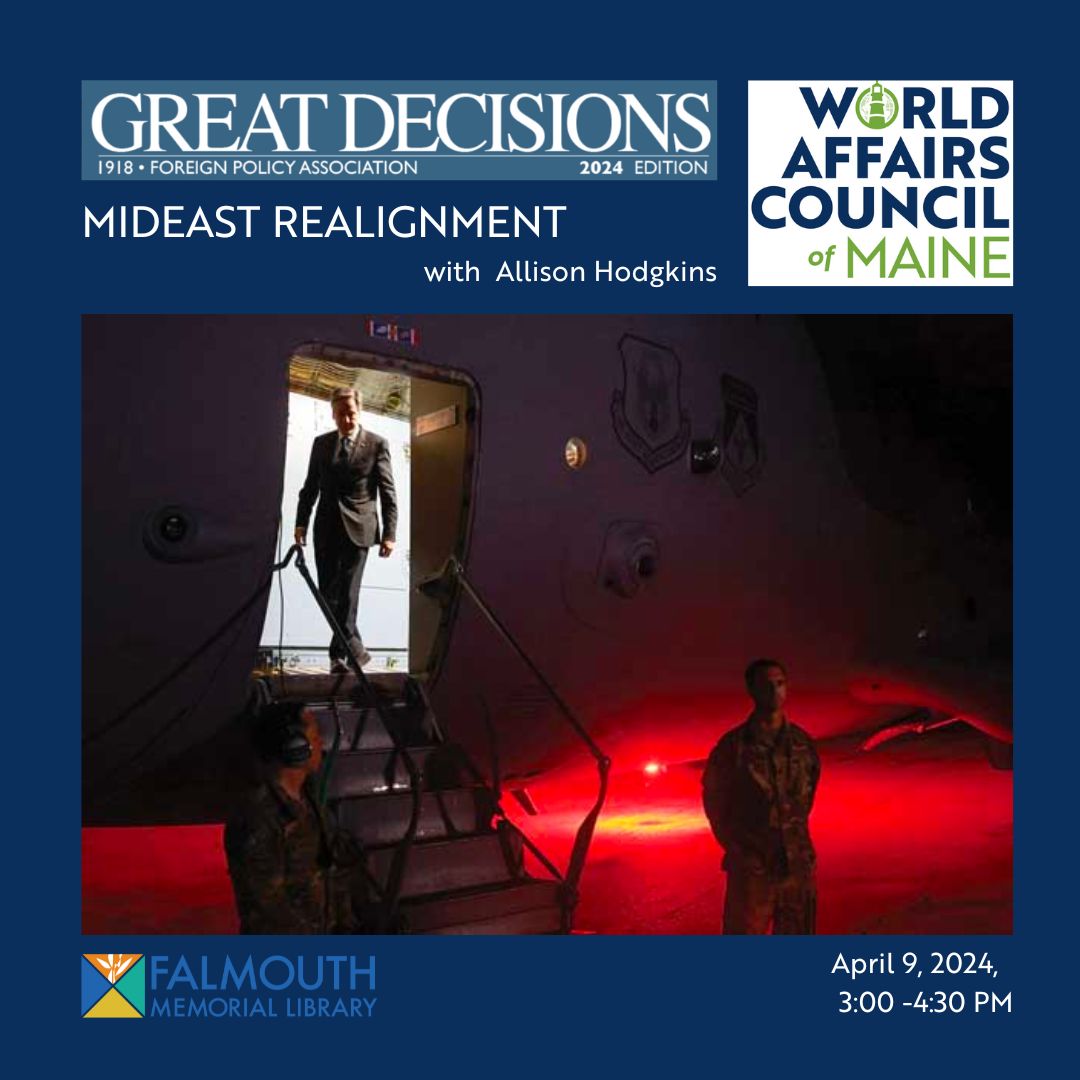 The United States and Middle East are at a crossroads. In spite of a reduced presence in the Middle East, the U.S. still has significant national interests there and the area is a key arena for global power politics. Can the U.S. continue to defend its interests in the Middle East and globally with a lower level of military and political involvement, or should it recommit to a leading role in the region?
Science Across Borders
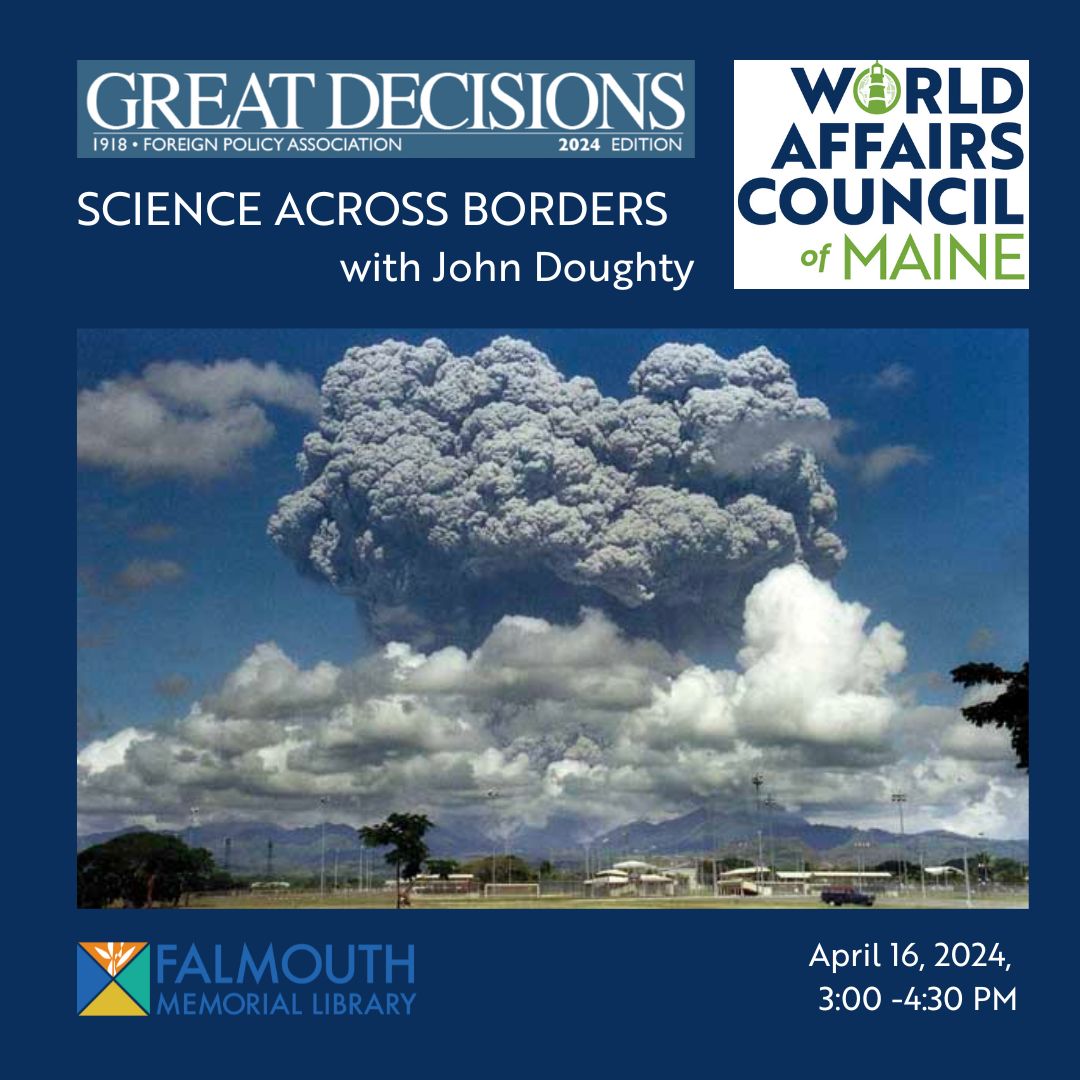 Scientific advances benefit from collaboration between researchers, but what happens when material, such as Artificial Intelligence (AI) is controversial and important to a nation’s national security? Is there a middle ground between sharing information and denying access? How can we regulate cooperation?
High Seas Treaty
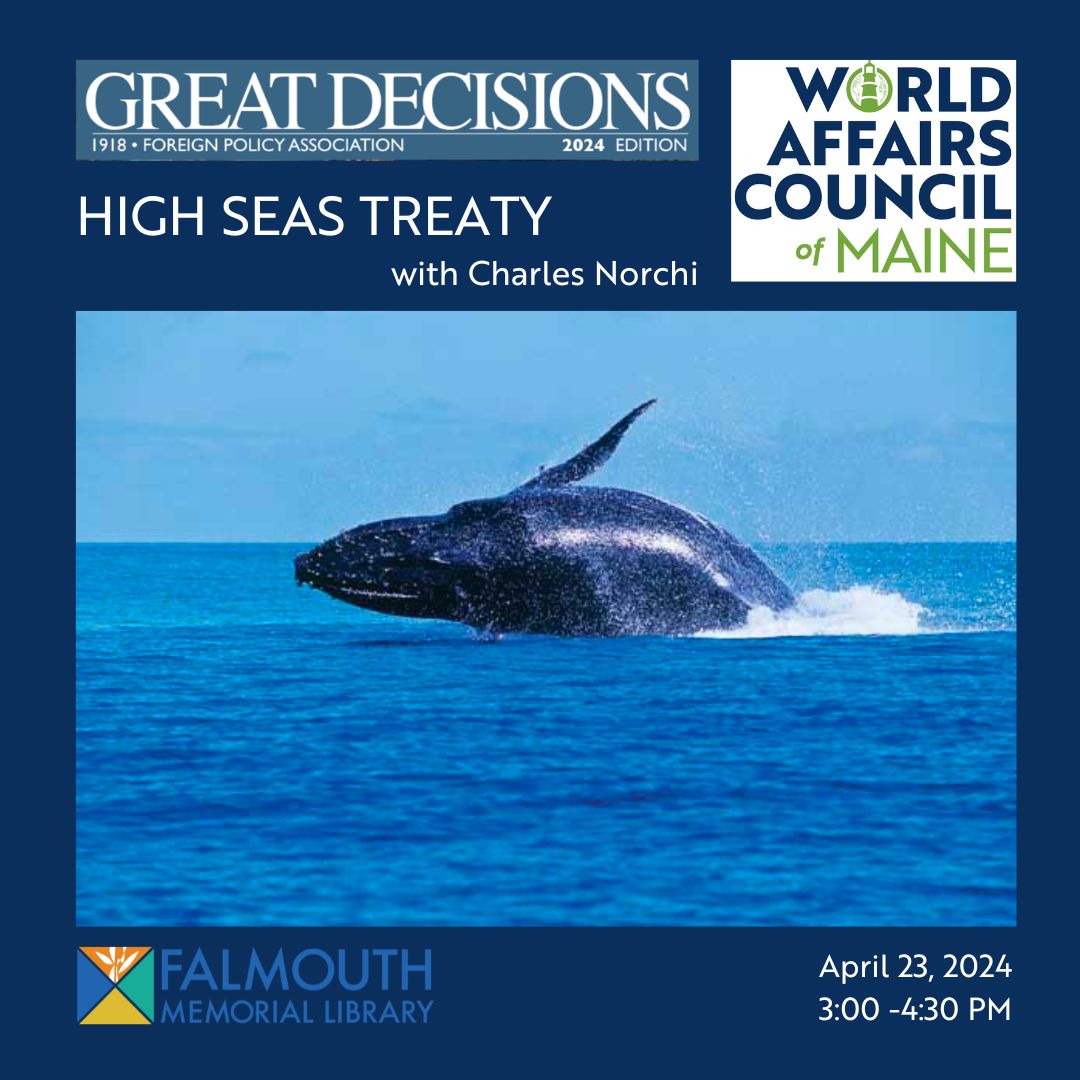 Areas of the seas beyond national jurisdiction comprise the high seas, which are facing a degradation of ecosystems due to climate change and the increase in human activities, such as shipping, overfishing, pollution, and deep-sea mining. The recently negotiated High Seas Treaty, also known as the Biodiversity Beyond National Jurisdiction treaty, will attempt to address these issues. How difficult will it be to convince nations to participate?
Pandemic Preparedness
 Looking back at the covid-19 pandemic, there are many lessons to take away in terms of domestic and international policies. Although this pandemic seems to have waned, how can we apply these lessons to future pandemics? Will countries cooperate, and will a consensus emerge on how to manage global health challenges?